

A Monumental Year for Engineering Markets
30th April, 2026
Authors: Olivia Grayland, Jack Brimmer, Connor Howell, Rhodri Skyrme, Kennith Ching, Aleks Perusko
Read time: 5 minutes
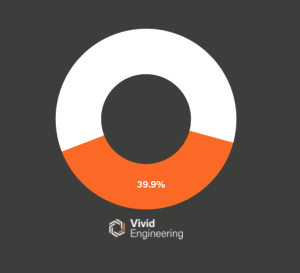
The engineering hiring market heading into FY25/26 reflects a sector that is not only dominant within the wider Vivid Resourcing ecosystem, but also evolving rapidly in response to macroeconomic pressure, technological acceleration, and shifting geopolitical realities.
Engineering accounted for 39.9% of all activity across FY25/26, making it the single largest contributor ahead of Tech, Government, Professional Services and Life Science sectors.
A market led by construction and transformation
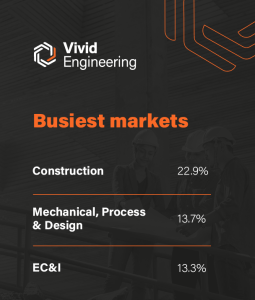
Unsurprisingly, construction remains the busiest sub-sector, accounting for 22.9% of all engineering hires. This sustained demand reflects continued investment into infrastructure and capital projects across Europe, particularly as organisations localise production and build resilience into their operations.
This is followed by mechanical process design (13.7%) and EC&I (13.3%), highlighting the ongoing need for core engineering expertise across complex industrial environments. At the same time, software & automation (11.3%) continues to grow in importance — evidence of the increasing overlap between traditional engineering and digital capability.
As Connor Howell (Benelux Engineering Managing Consultant) notes, this convergence is being accelerated by both macroeconomic and technological forces: clients are “investing in local software, local energy sources, [and] local products/raw materials,” while also adapting to “the AI boom… to help stay ahead of the curve.” The result is a broad increase in demand across engineering disciplines, supporting both physical and digital transformation.
Supporting functions such as HSE (9.1%) and QA/QC (6.7%) remain critical, particularly as regulatory scrutiny increases. In Belgium, this trend is already evident. Benelux Engineering specialist Aleks Perusko highlights a “notable increase in demand for freelance quality consultants… driven by evolving legislation and more stringent audit requirements,” particularly within the food sector. Alongside this, he notes “growing demand for inspectors across chemical and industrial sites,” fuelled by increased construction activity and project expansion.
Regional divergence shaping demand
While some markets are accelerating, others are facing more challenging conditions. In Belgium’s chemical sector, for example, Samuel Garven observes that “a downturn in Q3, driven by economic and global competitiveness pressures… has increased costs and slowed investment,” with the effects continuing into FY26/27.
In contrast, Germany’s defence sector is experiencing significant growth. Increased government spending is translating directly into hiring demand, particularly within unmanned systems. As defence staffing specialist Rhodri Skyrme explains, defence organisations are “prioritising engineers with embedded software, autonomy, sensor fusion, and secure communications experience” as programmes shift from R&D into production.
This transition is not without its challenges. Skyrme highlights that “candidate availability at the senior level remains constrained,” leading to increased competition, higher rates, and longer hiring timelines. As a result, organisations are relying more heavily on specialist recruitment partners to access hard-to-find talent.
The data centre boom and shifting investment priorities
One of the most significant demand drivers moving into FY26/27 is the rapid expansion of data centre infrastructure.
Jack Brimmer – Benelux Electrical Engineering Staffing Team Lead – points to “a sharp upturn in the Netherlands & Belgium, particularly in the data centre industry,” with electrical and mechanical roles in high demand as “projects ramp up now that financial budgets have been approved.” This trend is expected to continue, with further growth already visible across Scandinavia, where major players are mobilising new sites and increasing demand for site-based engineering talent.
This shift is also influencing candidate behaviour. Joe Wagg notes that many project planning professionals are proactively repositioning themselves, with “a huge shift in focus from old markets to new,” as candidates look to gain experience in data centre construction — an area where “investment continues to replace that of other markets, such as the chemical industry.”
At the centre of this trend is the exponential growth of AI and its infrastructure requirements. As Howell highlights, “AI demands massive computational power, energy and specialised GPU hardware,” pushing demand for data centre capacity significantly beyond supply. This imbalance is now cascading into the engineering market, creating sustained demand across civil, mechanical, electrical, and compliance-focused roles.
Evolving skillsets and talent shortages
Across the board, demand for specialised and hybrid skillsets continues to rise. In Germany, Kenneth Ching notes that “project-led investments across Industrial, MedTech and Automation will continue to drive demand for experienced embedded software consultants,” reinforcing the growing importance of software expertise within engineering environments.
At the same time, senior-level talent shortages remain a consistent challenge across regions and sectors. This is pushing clients to rethink traditional hiring strategies, placing greater emphasis on transferable skills and cross-sector experience.
As Brimmer explains, geopolitical pressures in sectors such as petrochemicals and automotive have required a shift in approach: “this has forced us to educate clients… on the transferable skills available to them from these traditional sectors,” creating new opportunities for both clients and candidates in emerging markets.
Looking ahead: Complexity creates opportunity
As FY26/27 progresses, the engineering hiring market is expected to remain highly active, but increasingly nuanced.
Growth will continue to be driven by data centre expansion, AI infrastructure, and defence investment, while traditional sectors face ongoing pressure from global competition and regulatory change. At the same time, localisation strategies and supply chain resilience will sustain demand for project-based and freelance talent across Europe.
What is clear is that the market is no longer defined by simple supply and demand. Instead, it is shaped by a complex interplay of technology, geopolitics, and shifting candidate priorities.
In this environment, success depends on access; to talent, insight, and networks that extend beyond the obvious. As hiring challenges become more acute and skill requirements more specialised, the ability to navigate this complexity is what ultimately sets organisations apart.
We’re here to help
- If you’re a manager needing assistance with your current or future hiring needs, contact us to be put in touch with a market expert.
- Have a question? Find out more about the services that can help you here.
- Looking for more insights? Check out the latest news.