

Technology across Europe: FY25/26 in Review
5th May, 2026
Authors: Olivia Grayland, Aharon Michel, Oscar Bridgman, Alexander Baranga, Jacob Westley, Vasilis Katopodis
Read time: 5 minutes
The technology hiring market in FY25/26 reflected a sector that remains central to business transformation, but is becoming increasingly defined by specialisation, integration, and evolving skill requirements.
While demand remained consistent across core areas such as infrastructure and software, the nature of staffing was changed by cloud adoption, AI acceleration, and growing pressure on security and data environments.
A Market Shaped by Infrastructure, Software, and AI
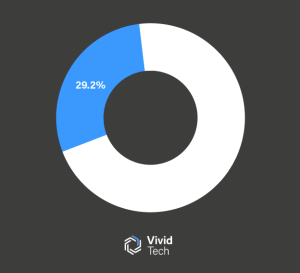
Technology accounted for 29.2% of all placements across FY25/26, reflecting its central role in both business transformation and operational delivery.
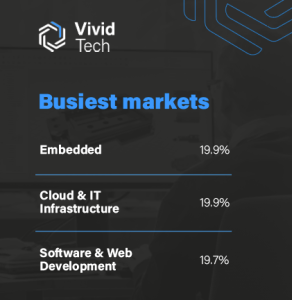
Within this, demand was spread across several core verticals, but with clear concentration in areas tied to infrastructure, software, and product development.
Cloud & infrastructure (20.0%) and embedded engineering
(20.0%) represented the joint largest share of activity, a reflection of continued investment into cloud environments, alongside the growing importance of product-level technology and connected systems.
20% Cloud & Infrastructure | 20% Embedded Engineering
This is consistent with what we’re seeing on the ground. As Antwerp-based consultant Alexander Baranga notes, Belgium’s infrastructure market continues to be “defined by strong demand for advanced skills, particularly in cloud, cybersecurity, and AI,” reinforcing the weight of these areas within overall hiring demand.
Software & web followed closely at 19.7%, reinforcing the ongoing need for development capability across both legacy modernisation and new product build. Increasingly, that capability is being shaped by AI integration, rather than traditional development alone.
Data, AI & analytics accounted for 14.5%, highlighting the growing importance of data-driven decision making and the integration of AI into existing environments. As David Ware highlights, this is translating into demand for engineers who can work directly with AI tooling, rather than treating it as a separate function.
More specialised areas such as digital & e-commerce (6.5%) and ERP & CRM (5.7%) remained steady, supporting commercial operations and internal system transformation.
Security & risk, at 5.5%, appears smaller in proportion, but its influence extends across all areas, increasingly embedded into infrastructure, software, and product development rather than operating as a standalone function.
“Security has become a bigger part of the infrastructure remit, with more clients expecting support and system engineers to have at least a baseline understanding of cybersecurity.”
— Aharon Michel, IT Infrastructure, Belgium
Security is embedded across all tech hiring
Software Demand Driven by AI Integration
In parallel, the software market has seen renewed momentum, driven largely by investment into AI and the growth of regional tech ecosystems.
Belgium’s software hubs Ghent, Antwerp, Brussels, and Hasselt, are continuing to scale rapidly, supported by sustained investment into emerging technologies. This has translated directly into demand, particularly for engineers who can work alongside AI tools and integrate them into existing systems.
This is already influencing onbaording expectations. As Benelux software expert David Ware highlights, demand is increasingly centred around engineers who can integrate AI tools such as Claude or Gemini into development environments, with this trend showing no signs of slowing as the market moves forward.
Rather than replacing traditional development roles, AI is reshaping what is expected of them. The focus is shifting toward adaptability and broader capability.
“Across Belgium, we’re starting to see a shift as the demand for software developers specialising in specific programming languages is being replaced by demand for more generalist knowledge across software and AI.”
— Jacob Westley, Belgium Software Staffing Consultant
Belgium’s Position as a Strategic Tech Hub
Despite ongoing talent shortages, Belgium continues to position itself as a key European technology hub.
Strong demand for advanced capabilities across cloud, cybersecurity, and AI is being sustained by a combination of strategic location and a multilingual workforce, alongside continued investment from sectors such as manufacturing, telecoms, finance, and the public sector.
“Belgium’s IT infrastructure market is defined by strong demand for advanced skills, particularly in cloud, cybersecurity, and AI, combined with a persistent talent shortage.”
— Alexander Baranga, Antwerp
Within this landscape, regional ecosystems are also becoming more distinct. As technology sales specialist Ian Mitchell outlines, Belgium’s SaaS market is spread across multiple cities with differing strengths, from product-led growth in Ghent, to enterprise platforms in Brussels, fintech in Antwerp, and deeptech innovation in Leuven.
This diversity is contributing to broad demand for talent, while also creating more nuanced requirements depending on location and company focus.
Talent Shortages and Evolving Expectations
Across both infrastructure and software, one challenge has remained consistent; access to experienced talent.
Senior-level professionals, particularly those who combine strong technical expertise with communication and stakeholder management skills, continue to be in short supply. This is increasing competition across the market, while also extending hiring timelines.
At the same time, the definition of “in-demand” talent is evolving, with hybrid skillsets, cross-functional knowledge, and adaptability becoming as important as depth in any single area.
“There’s been a real shortage of senior engineers who combine strong technical troubleshooting with the ability to communicate well with end users and stakeholders.”
— Aharon Michel
Looking Ahead: Integration over Specialisation
As the market moves into FY26/27, demand is expected to remain strong, but increasingly focused on how technologies are integrated, rather than adopted in isolation.
AI will continue to play a central role, but its impact is likely to be more nuanced than initial expectations. As Embedded Software specialist Joel Isaac notes, it is unlikely to replace engineers, but will instead “make top talent stand out,” amplifying the output of those who can use it effectively.
At the same time, organisations are moving beyond experimentation and into application. As Oscar Bridgman – Netherlands AI consultant – highlights, more companies are transitioning into early-stage AI adoption, embedding these capabilities into day-to-day operations, expanding demand beyond specialist teams and into wider business functions.
Infrastructure and security will also remain key focus areas. Infrastructure consultant Seppe Berghmans points to growing demand for cybersecurity compliance, particularly as organisations align with regulatory frameworks, while Vasilis Katopodis highlights the increasing importance of edge AI and real-time systems operating locally on devices.
“Edge AI is becoming the market standard in products… with security becoming mandatory as devices remain constantly connected.”
— Vasilis Katopodis, Embedded Engineering Specialist
Alongside this, investment into automation, data, and resilience is expected to continue shaping demand, particularly in sectors such as manufacturing and consumer goods, where supply chain transformation is becoming a priority.
What This Means for Hiring
As with engineering, the technology market is becoming less defined by volume alone, and more by complexity.
Demand remains high, but it is increasingly specific, shaped by overlapping factors including AI, infrastructure evolution, security requirements, and changing skill expectations.
In this environment, hiring is no longer just about finding talent, but about accessing the right capabilities at the right time, particularly as competition for experienced professionals continues to intensify.
We’re here to help
- If you’re a manager needing assistance with your current or future hiring needs, contact us to be put in touch with a market expert.
- Have a question? Find out more about the services that can help you here.
- Looking for more insights? Check out the latest news.