

What Shaped FY25/26? A Year in Review Across Vivid Resourcing’s Core Markets
22nd April 2026
Authors: Olivia Grayland, Vivid Resourcing Consultants; UK, Germany, Belgium, Netherlands, USA
As we close out FY25/26, we’ve taken a step back to assess how hiring demand has evolved across Vivid Resourcing’s core markets: Technology, Engineering, Government, Professional Services and Life Sciences.
Over the year, a clear pattern emerged. Projects moved from planning into delivery, increasing both the scale and complexity of hiring, while regulation, infrastructure investment and rapid technological change reshaped demand.
As a result, recruitment became more targeted and time-sensitive, with greater emphasis on specialist skillsets, mobility and immediate impact.
In this report, we break down placement trends by region, sector, industry and skillset, alongside consultant insight into what drove demand — and where momentum is building as we move into FY26/27.
The Year as a Whole: Where Demand Emerged
The full-year view highlights a market shaped by delivery cycles, regulation, technological acceleration and widening skill gaps.
Sector Split: Engineering at the Core
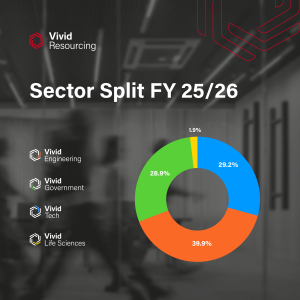
Engineering led FY25/26, accounting for 39.9% of all placements. This was driven by infrastructure delivery, facility upgrades and projects progressing into commissioning phases, particularly across Europe.
Across DACH, early investment in modernisation to remain competitive created strong initial demand, before shifting into commissioning, where the need for highly specialised engineers intensified. At the same time, wider industrial dynamics reshaped where demand sat.
Germany’s increased defence spend, for example, drove demand for engineers across embedded systems, autonomy and secure communications, as projects moved from R&D into delivery. In parallel, slower activity in traditional sectors like chemicals and automotive pushed both clients and candidates toward growth areas such as energy, data centres and advanced manufacturing:
“Germany’s increased defence spend across FY 2025 and 2026 had strong hiring demand across UxV (air, land, and maritime) development programmes.”
“Defence primes and specialised SMEs prioritised engineers with embedded software, autonomy, sensor fusion, and secure communications experience as unmanned platforms move from R&D into scaled production.”
– Rhodri Skyrme, Düsseldorf – Defence Sector Specialist
As one consultant revealed, candidates have increasingly repositioned themselves toward data centre construction, reflecting where long-term investment is now concentrating:
“For project planning, last year saw a huge shift in focus from old markets to new for many of the candidates that we work with in Germany and wider Europe. Sensibly, most candidates have been looking to add data center construction experience to their profile as investment in this market continues to replace that of other markets which have done well in the past 5 years or so eg the chemical industry”
– Joe Wagg, Düsseldorf – DACH Project Planning Hiring Specialist
Technology followed at 29.2%, with demand driven predominately by AI adoption, cloud migration, cybersecurity and data transformation. Across Benelux in particular, the market evolved toward more flexible, hybrid skillsets, with clients prioritising engineers who can operate across cloud, infrastructure and security environments.
“We’ve seen a clear shift towards hybrid skillsets – clients want engineers who are comfortable across on-prem, Azure, and M365 rather than purely traditional infrastructure profiles.”
– Aharon Michel, Antwerp – IT Infrastructure Consultant
There was also a clear shift in software hiring. Rather than deep specialisation in a single language, demand increasingly favoured broader, AI-enabled capability, as businesses looked to integrate emerging tools into real-world environments.
This was amplified by the growth of startup ecosystems – particularly from Q3 onwards – where investment in AI and data created intense competition for talent.
Government accounted for 28.9%, shaped heavily by regulation and structural change. In the UK, this was particularly evident across building control and legal markets, where new frameworks and local government reorganisation drove sharp increases in demand.
“Within Building Control we saw a massive spike in the need for Class 3H RBIs as more an more private sector companies took on BSR work so needed the staff to help out with this, alongside this, as more and more companies joined the BSR framework, we saw a increase in clients needing Class 3 RBIs to help accommodate the work”
– Lauren Porteous, Manchester – Building Control Hiring Specialist
In the legal sector, this translated into both volume and scarcity. Governance lawyers were in particularly high demand due to restructuring, while areas such as adult social care saw persistent candidate shortages, leaving many roles unfilled and increasing reliance on specialist support.
“Within the last financial year in the Government legal team, we noticed a particular demand for Governance Lawyers, given the Local Government reorganisation causing a lot of change for most authorities. The legal team kept up-to-date with relevant legislation and were able to identify this early, meaning we were able to assist clients with the huge influx in work. There was a real shortage of adult social care lawyers, with many roles on the market, but a lack of available candidates. This is a key area where we’ve supported clients throughout the year.”
– Georgia Howe, Manchester – Interim Legal Hiring Specialist
Life Sciences represented 1.9%, though this masks a more targeted recovery. Demand increased for QA/QC and validation professionals, particularly in Belgium, where evolving legislation and stricter audit requirements drove hiring within regulated environments.
Regional Split: Benelux Leads, UK Close Behind
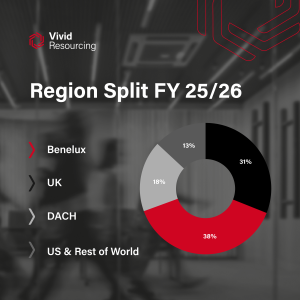
Benelux was the strongest-performing region at 38.37%, combining consistent engineering demand with a rapidly evolving technology market. A major driver here was localisation. In response to supply chain instability, rising costs and geopolitical uncertainty, organisations increasingly invested in local production, energy and infrastructure. This shift drove demand for freelance engineering and IT talent, particularly across projects supporting regional capacity.
At the same time, the region’s technology landscape accelerated. From Q3 onwards, startup ecosystems – particularly in the Netherlands – drove increased demand for software, data and AI talent, adding further pressure to an already candidate-short market.
“The Belgium software market has seen a renewed vigour over the last year with software hubs across Ghent, Antwerp, Brussels and Hasselt churning out innovative startups at a rapid pace with the continued investment in AI – This has resulted in a shift within hiring to needing Software Engineers proficient at integrating within AI such as Claude or Gemini.”
– David Ware, Belgium Software Staffing Consultant
The UK followed at 31.05%, with demand shaped by regulation, restructuring and capacity constraints. Across both public and private sectors, organisations increasingly relied on interim talent to maintain continuity.
In legal markets, this pressure was particularly visible, with some firms forced to turn away work due to a lack of available resources – reinforcing the importance of access to specialist talent pools.
DACH accounted for 17.5%, reflecting project-driven fluctuations. Early-year activity was driven by facility upgrades, followed by strong commissioning demand. While sectors such as automotive and chemicals experienced decline, this was offset by growth in energy, defence, data centres and embedded systems.
“The Belgian chemical sector experienced a downturn in Q3, driven by economic and global competitiveness pressures, with regulatory changes acting as a secondary factor that has increased costs and slowed investment, we’re still seeing the effect of this now”
– Samuel Garven, European Chemical Sector Hiring Expert
US & Rest of World contributed 13.08%, representing a key growth area. Across Scandinavia, Vivid continued to build its presence in engineering markets, while the US – as a relatively new office – gained traction in technology recruitment, particularly across cloud, infrastructure and transformation hiring.
While growth continues, hiring behaviour is becoming more measured.
“Companies are still cautious on overall headcount, but there’s real competition for top-tier talent – especially those with niche or emerging skillsets like AI, data tools and newer technologies. We’re also seeing a shift toward more strategic hiring, where productivity and long-term value matter more than rapid expansion.”– Donovan Pacette, North Carolina – US IT Infrastructure Staffing Consultant
A Market Defined by Delivery, Regulation and Talent Scarcity
Across the year, hiring became more precise and increasingly aligned to delivery.
Clients placed greater emphasis on immediate impact, cross-functional capability and adaptability, particularly within technology and infrastructure roles. The expectation is no longer just technical ability, but the ability to operate across environments and contribute to wider project outcomes.
At the same time, talent shortages remained a constant theme; particularly across engineering, AI and infrastructure. Demand for advanced skillsets continues to outpace supply, creating longer hiring cycles and increasing competition across key markets.
“Belgium’s IT infrastructure market is defined by strong demand for advanced skills—particularly in cloud, cybersecurity, and AI—combined with a persistent talent shortage. Its central European location and multilingual workforce make it a strategic hub for international operations, while key industries such as manufacturing, public sector, telecom, and finance continue to drive sustained investment in digital infrastructure.”
– Alexander Baranga – Antwerp – Belgium IT Infrastructure Specialist
The Road Ahead: FY26/27 Outlook
Looking ahead, several themes are already emerging.
AI will continue to reshape hiring; not by replacing talent, but by increasing the value of those who can use it effectively. As one consultant noted, engineers who can leverage AI tools will deliver significantly more impact, further widening the gap between top and average performers:
“Over the next year in the software industry, AI will have a real impact however it won’t be replacing engineers; it will make top talent stand out, as those who can leverage it will deliver 10x more impact.”
– Joel Isaac – AI & Embedded Expert across the Benelux
This shift is already moving organisations from experimentation into adoption, with AI becoming embedded into day-to-day operations, expanding demand beyond specialist teams into broader business functions.
Cybersecurity is also set to become a defining priority, as organisations work toward compliance across multiple frameworks, particularly in IT and operational technology environments.
“I see an upcoming demand within companies getting cybersecurity compliant through different frameworks and this will be the main aspect for 2026 within IT/OT Security”
– Seppe Berghmans, Antwerp – Infrastructure Hiring Expert
In the public sector, regulation will remain a key driver. New frameworks are expected to increase demand not only for highly experienced professionals, but also for mid-level talent; creating opportunities to both address shortages and support workforce development.
Legal markets are also expected to become more active, with local government reform increasing reliance on contract professionals as permanent hiring remains constrained.
Alongside this, enterprise adoption of AI platforms is now moving into scale:
“As organisations move from initial adoption into scaling platforms like Foundry and AIP, we’re seeing a clear increase in demand for forward-deployed engineers – particularly across regulated industries such as utilities, manufacturing and financial services.”
– Aman Padam, North Carolina USA – Palantir engineer staffing specialist
Across engineering, demand will continue to be shaped by project-led investment, particularly across industrial, MedTech and automation sectors. At the same time, the growth of data centres – driven by AI’s infrastructure requirements – will sustain demand across a wide range of engineering disciplines.
“Project-led investments across Industrial, MedTech and Automation will continue to drive demand for Experienced Embedded Software Consultants going into the new financial year.”
– Kennith Ching, Düsseldorf – Embedded Software Specialis
Conclusion
FY25/26 reflects a clear shift. Hiring is increasingly driven by project delivery, regulation and access to specialist capability, rather than headcount growth alone.
As markets continue to evolve, success will depend on speed, precision and deep technical expertise – aligning talent to complex, real-world delivery challenges.
This remains central to how Vivid supports clients and candidates across its core markets.
Wondering how each sector performed? Stay tuned for our deep dives into each sector later this month.
We’re here to help
- If you’re a manager needing assistance with your current or future hiring needs, contact us to be put in touch with a market expert.
- Have a question? Find out more about the services that can help you here.
- Looking for more insights? Check out the latest news.